Sensory homunculus
Last updated: Sun, Mar 2, 2025
This page discusses changes to the physical structure of the brain that have been observed in chronic pain patients.
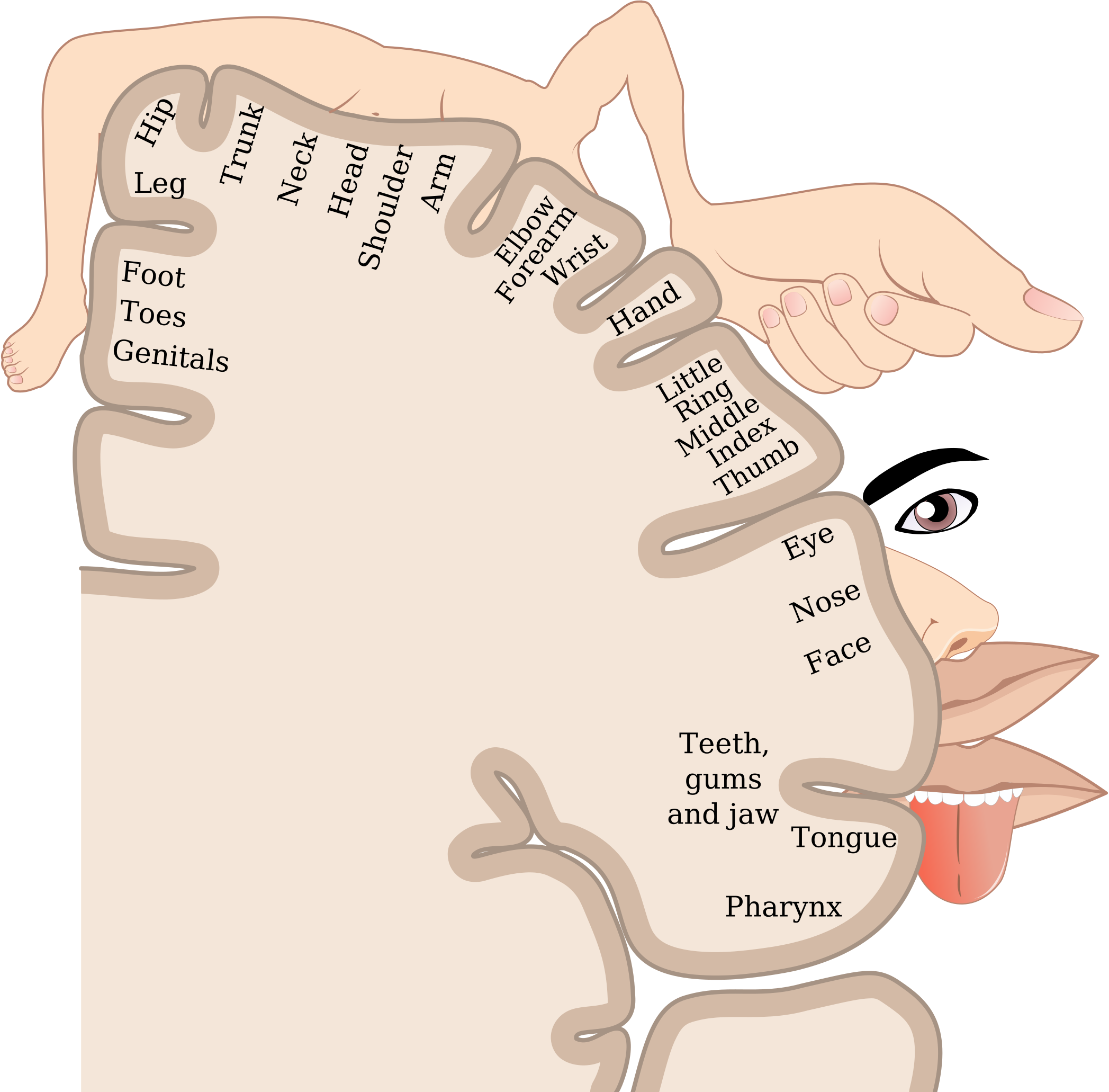
Perhaps you recall the sensory homunculus that represents the somatotopic organization of the primary somatosensory cortex, S1. This diagram shows a cross-section of the neocortex, from the center to one side. The relative sizes of body parts show that some parts of the body are more heavily innervated than others.
S1 is just one of many areas of the CNS that is somatotopically organized. S2, the secondary somatosensory cortex, and regions of the thalamus are similarly organized, but they are more difficult to represent as a diagram.
The amount of somatosensory cortex used by a body area is the result of at least two factors. First, some areas, such as the fingertips, are very densely innervated. Second, some areas are used more than others. The homunculus is plastic over time in response to usage. A piano player or a massage therapist may have a larger hand on the diagram than some others do. The size of the homunculus' hand(s) for such people would increase over time with practice.
Several lines of evidence show that both extreme and persistent pain can cause an expansion of the extent of nociceptive innervation in S1 and in other somatotopically organized brain areas. A study in 1983 subjected kittens to painful stimuli. Analysis of brain tissue showed that the body parts that had been subjected to pain had larger representation in both the cortex and the thalamus.1
The effect of this larger representation is that the individual is more likely to experience pain when the affected body part is stimulated, and is likely to experience a higher intensity of pain.2
This same effect seems to be the cause of phantom limb pain. (Phantom Limb Pain and Referred Pain.) When a limb is amputated, the sensory nerves from the amputated limb are cut. This leaves the somae of the sensory nerves alive in the dorsal root ganglion, but with no sensory signals arriving. One of the negative effects of this is that sensory nerves from areas of the body that are neurologically adjacent to the cut nerves grow into the areas of cortex that used to receive sensory input from the amputated limb. These invading dendrites connect in innocuous and in nociceptive areas of the vacated cortex. The result is that stimulation of the neurologically-adjacent body area can trigger innocuous and nociceptive sensations that are perceived as if they came from the amputated tissue.
When amputation is the result of traumatic injury, the amount of phantom limb pain is proportional to the amount of reorganization of S1, which in turn is positively correlated to the amount (intensity and duration) of pain that the victim experienced prior to amputation.3 Cortical reorganization occurs not only in S1, but in other areas of the pain matrix, thus affecting the functions of this other areas (Functional Alterations in the Pain Matrix Under Chronic Pain).
Brain imaging has shown that the portion of the primary somatosensory cortex (S1) that is concerned with pain in the painful part of the body expands progressively in chronic pain. This phenomenon is called cortical reorganization. This process also affects other parts of the pain matrix that are somatotopically organized. The effect of this enlargement is to increase the sensitivity of the affected body part. On top of this, increased cortical excitability is seen in chronic pain patients. This excitation may facilitate cortical reorganization.
From the perspective of behavioral psychology, cortical reorganization in response to pain and injury can be seen as the creation of Non-declarative, implicit, or somatosensory pain memories that are manifested as an altered representation of pain-affected body parts in the brain.
4 Such "memories" exist as alterations to the neural connections of affected body parts within the cortex, and increase the sensitivity of these body parts to both painful and innocuous stimulation.
Cortical reorganization serves as at least a partial explanation of the pain sensitivity of body parts based upon past physical/sexual trauma.5
Such memories aren't accessible to consciousness in the way that explicit memories are, and hence are unlikely to be treatable by CBT techniqes (Cognitive-Behavioral Theories of Pain.). Treatment of such sensitivity requires reforming of the neural connections that are involved. Such treatments are being developed for conditions such as phantom limb pain and some regional pain syndromes. In other conditions in which such reorganization is caused and maintainec by noxious signaling, cessation of the signals results in gradual reversal of the changes that were caused by pain.
A number of studies have reported decreases in brain gray matter in patients and experimental animals with extended pain. (Gray matter indicates the presence of neuronal cell bodies and dendrites.) These changes have been seen in both prefrontal cortex (PFC), the ACC, the IC, and the thalamus.6 Larger decreases are seen in patients with a longer duration of pain. A study of patients with trigeminal neuralgia, a neuropathy in the nerves that serve portions of the face, indicated that the thinned cortex occurred in the same area that was active while the patients were in pain.
A substance known as N-Acetylaspartate or NAA has been used together with proton magnetic resonance spectroscopy to estimate the amount of total neuronal tissue in various brain regions. (NAA is the second most-abundant molecule in the brain, and indicates the presence of neuronal tissue.) One small study of elderly healthy individuals showed that higher levels of chronic pain correlated with lower amounts of NAA in the hippocampus, and with smaller hippocampal volume. A study of fibromyalgia patients also showed lower amounts of hippocampal NAA. Another study of fibromyalgia sufferers indicated lower hippocampal NAA with greater pain. Thus, both studies based on tissue size and on NAA levels indicate that protracted pain goes with reduced gray matter.
The significance of the changes in gray matter is not understood. It is suspected that reductions in gray matter may increase pain, and there is some evidence that the reductions may be associated with increases in anxiety. A study of neuropathic pain in rats showed thinning in the prefrontal cortex several months after nerve injury. The occurrence of gray matter changes in these rats coincided with development of anxiety-like behavior.7
Several studies have now found that the gray matter returns to normal if the pain is stopped. This indicates that neurons are not killed, and that the reduction in gray matter is due to a reduction of dendrites and synapses.8
White matter in the central nervous system indicates the presence of axons with their accompanying myelin. Imaging studies have found changes in the isotropy of axons in certain brain regions. (Isotropy, roughly speaking, is the degree to which axons travel in parallel.) A 2008 study found reduced isotropy in the cingulate cortex of patients suffering from CRPS (complex regional pain syndrome, See Wikipedia). This finding could be caused either by reduced myelination of the axons, or by reduced parallelism of axon fibers. Fewer white-matter connections were also found to originate in the area of reduced isotropy.
Another study, of fibromyalgia sufferers, showed that decreased isotropy in the thalamocortical tract was associated with increased bodily stiffness.
A study that looked at the amount of white matter in migraine sufferers found that sufferers with more frequent attacks also had lower levels of white matter in frontal and parietal areas of the cortex.9