Please use the form below to submit comments. Also provide an e-mail address and name. Your e-mail address and/or name will be used only to communicate with you about this or future comments you may submit. I am particularly keen to receive references to published material that contradicts the assertions and arguments I have made.
By submitting the above comment, I grant to Ross Alan Hangartner the right to incorporate the comment in full or in part, literally, paraphrased, or conceptually, as he sees fit, into State of Pain or other writings that he may create in the future. However, I don't grant permission to include my name or e-mail address, or to use them in any other way than to contact me for follow-up. I understand that by submitting the comment I acquire no right of any kind in State of Pain or other writings of Ross Alan Hangartner.
Last updated: Tue, Nov 19, 2024
As you move from the periphery into the spinal cord, you move from an area of individual neurons to an area of heavily connected neurons. Although these spinal neurons appear to be a jumbled mass of tissue, they are highly organized. If they weren't, they wouldn't be able to conjure up an orderly and useful view of the world for us. In the previous section you saw several phenomena that can't be understood without explaining how central processes can combine, separate, prioritize, mute, or highlight signals arriving from separate neurons. I'll begin by illustrating how neurons can combine to form useful signal processors.
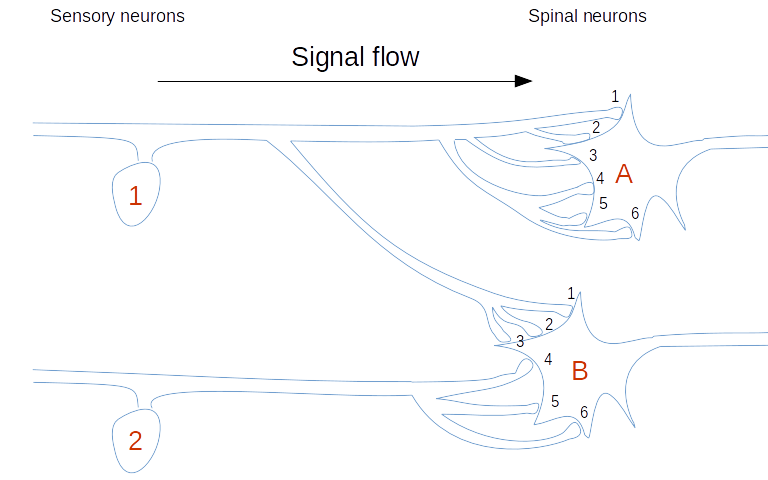
Figure 1: A simple neural circuit1 is a schematic diagram that shows signals flowing in from the left and out to the right. The diagram shows a small number of fibers, each with a small number of terminal branches, and a small number of dendrites on a small number of neurons after the synapses. In the real central nervous system a single neuron can have tens of thousands of terminals within an area of several cubic millimeters. The schematic view has the advantage that it is easy to comprehend.
Assume for now that each of the synapses is excitatory. When it fires, it increases the voltage of the postsynaptic (downstream) neuron by releasing a neurotransmitter that, once it has bound to the postsynaptic terminal, admits a brief flow of positive ions. This raises the voltage inside the postsynaptic neuron. The activation of a single excitatory synapse won't ordinarily raise the excitation of the receiving neuron enough to cause it to fire. Instead its voltage will first increase slightly, then decrease over a period of about fifteen milliseconds to its resting level. However, if multiple excitations occur simultaneously or over a short period, it will cause the postsynaptic neuron to fire. This phenomenon is called summation.
Summation can be spatial, when impulses add up over an area. An example of spatial summation occurs when a pointed pressure stimulus is applied to the skin. Added pressure increases the area of skin that is deformed, which increases the number of receceptors, the number of fibers, and the number of neurons that are stimulated. Summation can also be temporal, that is, summed over time. If the presynaptic neuron discharges rapidly enough, its input summates and can generate an action potential in the postsynaptic neuron.
Looking again at Figure 1: A simple neural circuit, suppose that neuron 1 fires. This will cause each of its terminals to fire. The figure shows that six terminals from neuron 1 synapse with neuron A. Assuming that six synapses is enough to fire neuron A, then each time neuron 1 fires, neuron A will fire. (The neurons that cause muscles to contract, for example, require forty to eighty synaptic discharges to cause them to fire.)
Next consider neuron B. Still assuming that six synapses must fire at once to cause neuron B to fire, it will fire if both neurons 1 and 2 fire at once or in close succession. However, neither 1 nor 2 is able to trigger neuron B on its own. Either 1 or 2 is said to “excite” neuron B, making it easier to fire with additional stimulation from any other neuron that synapses with it. (In real central nervous tissue, neuron B would receive terminals from many other neurons. The dendrites of the neurons that cause muscle to contract extend from 0.5 to 1.0 millimeter from the neuron's soma and can connect to thousands or tens of thousands of synapses.)
Assume next that neuron 2 is inhibitory, not excitatory. This means that when it fires, neurons that connect to its terminals become less excited rather than more. In this case, if neuron 1 fires alone, it will excite neuron B, but will not cause B to fire. If neurons 1 and 2 fire together, or if neuron 1 fires shortly after neuron 2 does, this will have no net effect on neuron B.The foregoing examples assume that the excitation or inhibition are short-lasting. Long-acting neurotransmitters can have an effect for hours or longer.
Within this section...
Circuits Formed from Neurons (Last updated: Sat, Feb 22, 2025)
Or skip to...
Organization of the Spinal Cord (Last updated: Fri, Jul 26, 2024)