Please use the form below to submit comments. Also provide an e-mail address and name. Your e-mail address and/or name will be used only to communicate with you about this or future comments you may submit. I am particularly keen to receive references to published material that contradicts the assertions and arguments I have made.
By submitting the above comment, I grant to Ross Alan Hangartner the right to incorporate the comment in full or in part, literally, paraphrased, or conceptually, as he sees fit, into State of Pain or other writings that he may create in the future. However, I don't grant permission to include my name or e-mail address, or to use them in any other way than to contact me for follow-up. I understand that by submitting the comment I acquire no right of any kind in State of Pain or other writings of Ross Alan Hangartner.
Last updated: Sat, Jul 27, 2024
In 1965 pain researchers Ronald Melzack and Patrick D. Wall built a new model for pain perception called the "gate-control theory" of pain. This was about the same time that I, then a high school sophomore, learned about pain in my Health class.
The model for pain that I learned was illustrated by a picture of a poor fool putting his hand down on a hot range burner. Pain was sent through his nerves up to his brain, which went "Ouch, you burned my hand!," and taught the poor fool not to do that any more. The model behind that narrative is known as the "specificity" theory of pain. It sees pain as a simple physical sensation like touch only more potent. A specific pain system responds to messages from specific pain receptors that travel through specific pain channels to the pain center in the brain, which knows that it is a pain sensation because it came from a pain nerve. The specificity model of pain is at least as old as the French 17th-centory natural philosopher Rene Descartes, who believed that nerves were literally like tiny bell cords. When they were pulled after being stimulated by, say, a hot stove top, they in a sense rang an alarm bell in the brain.
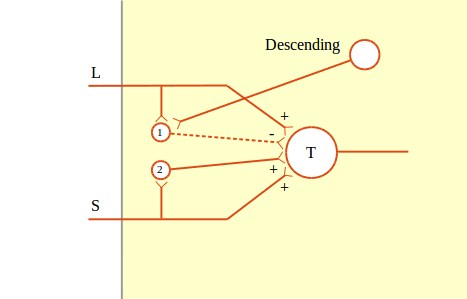
At the time that Melzack and Wall proposed gate control, the physiologic evidence to support it was incomplete. Since then, the theory has been thoroughly confirmed and expanded. Figure 1: Gate control model is a diagram of the gate-control system as it was proposed in 1965. Each circle in the model represents not a neuron, but a function that is performed by one or many neurons. T in the diagram is the neuron or neurons that transmit the resulting signals to centers above the spinal cord. Signals from A-delta and/or C fibers arrive on the S or "small" line. They stimulate T. It was known at the time the model was proposed that a short volley arriving on line S results in a sustained signal on T. Function 2 was added to apply stimulating signals to T, to account for the extended firing of T. Signals from A-beta (innocuous) fibers arrive on the L or "large" line. It was known at the time that L signals at some times stimulate T and at other times dampen T. Function 1 was added to generate inhibitory signals based on signals arriving through L. Finally, it was known that signals descending from the brain inhibited T, so the Descending source of signals to the inhibitory function 1 was added to the model.
Three types of neurons can be found among the spine's ascending projection neurons: 1) neurons that respond only to low-threshold (innocuous) sensory signals; 2) those that respond only to high-threshold signals (known as NS or nociceptive-specific); 3) those that respond to either type of signal (known as WDR or wide-dynamic-range neurons). At the time the gate-control theory was developed, adherents to the specificity model identified the NS projection neurons as "pain neurons." It has been found, however, that neurons change their character from NS to WDR and back under the influence of local and descending modulation, and that the brain must analyze the signals carried by these neurons to "decide" which are painful.1