Please use the form below to submit comments. Also provide an e-mail address and name. Your e-mail address and/or name will be used only to communicate with you about this or future comments you may submit. I am particularly keen to receive references to published material that contradicts the assertions and arguments I have made.
By submitting the above comment, I grant to Ross Alan Hangartner the right to incorporate the comment in full or in part, literally, paraphrased, or conceptually, as he sees fit, into State of Pain or other writings that he may create in the future. However, I don't grant permission to include my name or e-mail address, or to use them in any other way than to contact me for follow-up. I understand that by submitting the comment I acquire no right of any kind in State of Pain or other writings of Ross Alan Hangartner.
Last updated: Tue, Feb 18, 2025
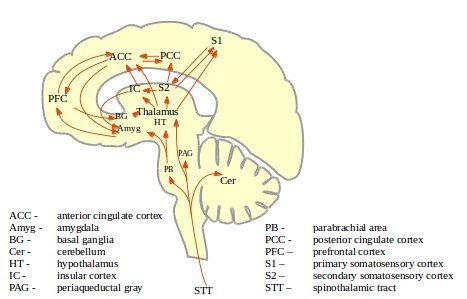
Figure 1: Ascending paths of the pain matrix1 shows the neural network for pain signals that rise from the spinal cord. The figure is a cross section through the brain that gives a rough idea where the major areas that process nociceptive signals are. (The brain is "facing" toward your left.)
The pain matrix or pain network is a group of brain areas that are frequently activated during imaging, EEG, and MEG studies of pain processing. These areas are largely the same areas that are innervated by fibers of the STT (The Ascending Tracts). The thalamus is central in the network. Input proceeds from the thalamus to several areas of the cortex: the primary and secondary somatosensory cortex, the anterior cingulate cortex, the insular cortex, and the prefrontal cortex. The cerebellum receives nociceptive input that hasn't passed through the thalamus. The amygdala and the basal ganglia receive nociceptive signals from areas of the cortex and also through the parabrachial area, PB.
The evidence indicates that different brain areas are responsible for different aspects of the complex sensations of pain.
Recall that the IASP defines pain as "an unpleasant sensory and emotional experience...." The pain matrix concept explains well the sensory portion of pain experience, but does a poorer job of explaining the emotional portion of that experience. Elements of the limbic system, sometimes characterized as the "emotional brain," are included in the pain matrix, but the physiological analysis of the pain matrix does a deficient job of dealing with emotions. See A Rational Model of Emotion and Pain for a more complete description of the important but neglected role that the limbic system plays in the lived experience of pain.
Within this section...
Components of the Pain Matrix (Last updated: Sat, Feb 22, 2025)
Functions of the Pain Matrix (Last updated: Fri, Feb 21, 2025)
Neurotransmitters in the Pain Matrix (Last updated: Sat, Mar 1, 2025)
"Psychological" Factors in the Pain Matrix (This page is incomplete.)
A Brief Critique of the Pain Matrix Analysis (Last updated: Sat, Feb 22, 2025)
Or skip to...
The Descending Tracts and Descending Pain Modulation (Last updated: Fri, Mar 7, 2025)