Please use the form below to submit comments. Also provide an e-mail address and name. Your e-mail address and/or name will be used only to communicate with you about this or future comments you may submit. I am particularly keen to receive references to published material that contradicts the assertions and arguments I have made.
By submitting the above comment, I grant to Ross Alan Hangartner the right to incorporate the comment in full or in part, literally, paraphrased, or conceptually, as he sees fit, into State of Pain or other writings that he may create in the future. However, I don't grant permission to include my name or e-mail address, or to use them in any other way than to contact me for follow-up. I understand that by submitting the comment I acquire no right of any kind in State of Pain or other writings of Ross Alan Hangartner.
Last updated: Mon, Apr 29, 2024
Sensory neurons have sensitive structures called receptors at the ends of their axons. There are many types of sensory neurons and many types of receptors. These are adapted to report on a range of conditions that are important to the proper functioning of our bodies. The receptors when stimulated pass messages into the spinal cord, which processes and filters them, and may pass them on up the spinal cord to the brain, where they are used to modulate our moods and behaviors.
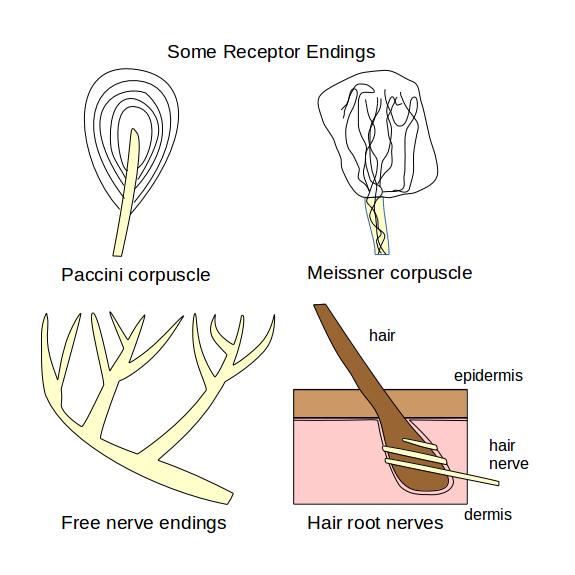
The figure shows several types of sensory receptors that occur in the skin. Each has its own structure and function. Paccini corpuscles are sensitive to high-frequency vibrations and to diffuse pressure. They are found in many places, including underneath the dermis (the top live layer of the skin) and around joints, tendons, and muscles. The nerve ending itself, which is shown in yellow, is surround by multiple layers of flexible membrane. Pressure applied to the membranes causes the tip of the nerve to stretch, which can cause a signal to be sent to the spinal cord.
Meissner corpuscles are somewhat like the end of a cotton swap. They are found immediately under the epidermis, in the most sensitive areas of skin: the fingertips. lips, and external genitalia. They respond to vibration and to light touch.1
Each hair root is surrounded by a complex structure that includes a hair nerve that winds around the root of the hair. This ending is sensitive to stretch, which allows us to receive neural messages when our hair is touched.
Free nerve endings are responsible for much of our pain, although other types of neurons also contribute. Some free nerves are sensitive to pressure or deformation, some are sensitive to changes in temperature, and others are sensitive to certain chemicals, particularly to chemicals that are present in the extra-cellular fluid when body tissues have been damaged. Because its endings are branched, the sensors respond not to a specific point in the body, but to an area. Any particular area of the skin, for example, can be innervated by multiple neurons with overlapping sensory fields.
Sensory neurons differ in the types of stimuli that cause them to fire, and also, as mentioned, they differ in the speed at which signals are transmitted to the spinal cord. All of this information has to be untangled and interpreted by the spine and brain to allow adaptive behavior.