Please use the form below to submit comments. Also provide an e-mail address and name. Your e-mail address and/or name will be used only to communicate with you about this or future comments you may submit. I am particularly keen to receive references to published material that contradicts the assertions and arguments I have made.
By submitting the above comment, I grant to Ross Alan Hangartner the right to incorporate the comment in full or in part, literally, paraphrased, or conceptually, as he sees fit, into State of Pain or other writings that he may create in the future. However, I don't grant permission to include my name or e-mail address, or to use them in any other way than to contact me for follow-up. I understand that by submitting the comment I acquire no right of any kind in State of Pain or other writings of Ross Alan Hangartner.
Last updated: Sun, Mar 9, 2025
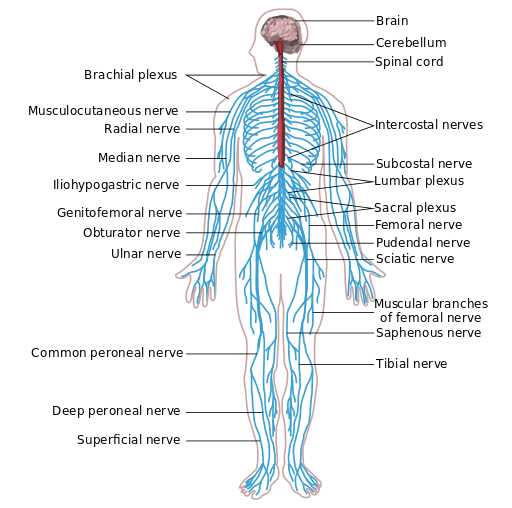
The human nervous system is made up of the brain, the spinal cord, and the peripheral nerves. See Figure 1: The somatic nervous system1 The central nervous system or CNS is made up of the spinal cord and the brain, which are shown in red and pink in the diagram. The peripheral nervous system or PNS is made up of the nerves outside of the brain and spinal cord.
This diagram is vastly simplified and omits peripheral nerves that have an important role in pain conditions. It shows only the major somatic nerves. The somatic nerves are the nerves that carry infornation about the body or "soma" into the central nervous system, and that carry commands out of the CNS to the muscles, bones, and connective tissues.
Besides the somatic nerves shown here, the peripheral nervous system includes about a dozen important unshown nerves that emerge from the upper spine that are called cranial nerves, that is, "head nerves." Most of the cranial nerves are like the other somatic nerves. They carry sensory information from the muscles, bones, and connective tissues of the head and neck into the central nervous system, and they carry commands out of the CNS to these muscles, bones, and connective tissues.
Also not shown in the diagram are the peripheral nerves of the autonomic nervous system or ANS. The ANS nerves enter and leave the central nervous system side-by-side with the somatic nerves, but they follow different paths to the tissues that they serve. The ANS nerves separate from the somatic nerves once they leave the spine. They travel through a network of nerves that run outside of the spine but parallel to it. These pathways include ganglions in which different nerve fibers come together, exchange messages, and pass off messages to additional neurons. The autonomic nerves carry information about the viscera (organs), blood vessels, skin, and other organs of the body into the CNS, and carry commands out from the CNS to these organs, to the sweat glands, to the hair erector muscles, and so forth. More about the autonomic nerves can be found at Pain Science 4: Partner Systems.