Please use the form below to submit comments. Also provide an e-mail address and name. Your e-mail address and/or name will be used only to communicate with you about this or future comments you may submit. I am particularly keen to receive references to published material that contradicts the assertions and arguments I have made.
By submitting the above comment, I grant to Ross Alan Hangartner the right to incorporate the comment in full or in part, literally, paraphrased, or conceptually, as he sees fit, into State of Pain or other writings that he may create in the future. However, I don't grant permission to include my name or e-mail address, or to use them in any other way than to contact me for follow-up. I understand that by submitting the comment I acquire no right of any kind in State of Pain or other writings of Ross Alan Hangartner.
Last updated: Sat, Feb 22, 2025
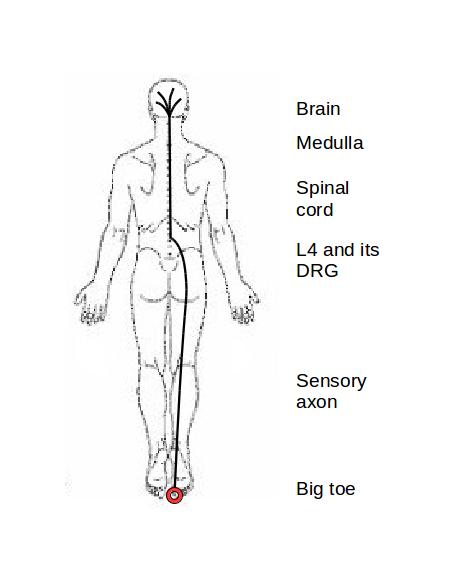
I've asserted, in the prior section, that the nervous system that creates your pain is complex. It also works with and for a complex body. In Figure 1: A Signal from the Big Toe I described the path of a single sensory neuron (from your big toe) into the spinal cord and hence into the brain, where the signal branches and spreads through multiple specialized computing components to generate sensations and feelings that identify the location of the affected tissue, identify the pain as painful, and provide additional perceptions and feelings which presumably are meant to assist you in some way in dealing with life.
Multiply that by a very large number to get an idea of the complexity of the whole pain system.
Your nervous system has been estimated to contain about one hundred billion neurons, most of which are in the central nervous system. That is one hundred followed by nine zeroes. There are about one hundred trillion connections among the neurons, one hundred followed by twelve zeroes.1
Each spinal cord segment (such the one diagramed), has several million neurons in its grey matter. This is enough neural matter to do some complex processing just at the spinal level.2
Every area of your skin, bones, ligaments, fascia, and most internal organs is served by sensory and motor, voluntary and autonomic nerves. Pain can be generated by signals from the sensory nerves that innervate nearly all these parts of your body.
Our brains are not only very complex, but they also vary greatly between individuals. More genes are involved in shaping the brain than any other tissue. Some experts believe that as many as sixty percent of our genes are involved in fashioning our brains. This means that we should expect behavior and perception to be highly variable between individuals.3, 4
The brain's cortex, the most "modern" or "human" part of the brain, includes perhaps thirty billion neurons, which are capable of making a million billion connections.5 This statistic suggests both the power and the variability that might be shown in brain function. As I'll explain (Pain Science 3: Neuroscience and the Brain), however, our brains are organized into specialized data-processing modules, which limits the brain's functional variability below what such numbers might suggest.6