Please use the form below to submit comments. Also provide an e-mail address and name. Your e-mail address and/or name will be used only to communicate with you about this or future comments you may submit. I am particularly keen to receive references to published material that contradicts the assertions and arguments I have made.
By submitting the above comment, I grant to Ross Alan Hangartner the right to incorporate the comment in full or in part, literally, paraphrased, or conceptually, as he sees fit, into State of Pain or other writings that he may create in the future. However, I don't grant permission to include my name or e-mail address, or to use them in any other way than to contact me for follow-up. I understand that by submitting the comment I acquire no right of any kind in State of Pain or other writings of Ross Alan Hangartner.
Last updated: Fri, Feb 21, 2025
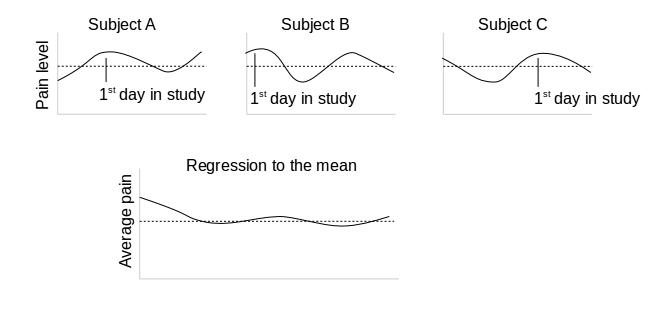
Irritable bowel syndrome (IBS) is a painful condition in which the level of pain fluctuates around an average level of pain that can remain steady for years. My own back condition has been similar at times—my pain went up and it went down, but on the whole 2006 was pretty much like 2007.
Patients are more likely to seek a doctor when their pain is up, and they are more likely to join a clinical trial then. If you were to conduct a clinical trial for IBS patients without accounting for this, patients would tend to join the trial when their pain was high, and at the end of trial, their pain would tend to be closer to their own long-term average value. This is called regression to the mean. Figure 1: Regression to the mean illustrates this.
A similar effect can occur because of the natural progression of an illness. (Doctors call it the natural history of the illness.) Headaches for which no particular cause can be found tend first to increase and then to diminish by themselves. If you perform a trial of patients with this sort of headache, you are bound to show improvement provided the trial lasts long enough.
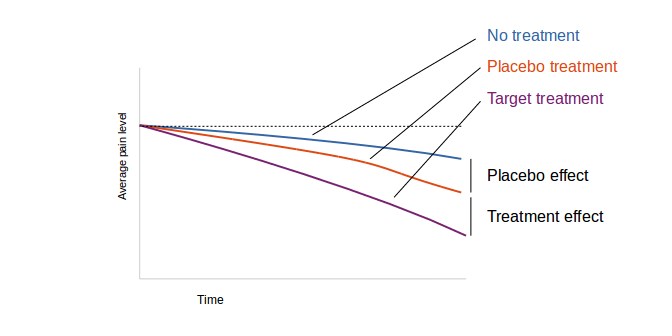
Because natural history and regression to the mean can affect study results, it's important to compare the treated group against a control group with similar characteristics. When this is done, the improvement often seen in the untreated group is often reported as a "placebo effect," and the untreated individuals who improved during the study are reported to be "placebo responders." This isn't quite right. The placebo effect is actually the effect of going through the treatment program with a sham or mock version of the treatment being tested.
The change in the untreated group is a combination of natural history and regression to the mean.
The change in the placebo group is a combination of the placebo effect, the natural history, and regression to the mean.
The change in the treated group is a combination of those three factors plus the effect of the treatment. Figure 2: Placebo effect and treatment effect illustrates this.
An influential study in 1955 reported that 30% of patients respond to placebo treatment. The study was based on analysis of trials in which no compensation was made for natural history and regression to the mean, so the 30% estimate is apparently a large overestimate.1
Now take a little different perspective on Figure 2: Placebo effect and treatment effect. Suppose it represents not a treatment experiment but you and your doctor working on your pain. You most likely consult your doctor when your symptoms are at their worst. Over time your symptoms improve. How much of the improvement is due to the treatments provided by your doctor, and how much is due to the natural history of your condition or to regression to the mean?
More information on the placebo effect and pain is included in the section, Placebo Analgesia.