Please use the form below to submit comments. Also provide an e-mail address and name. Your e-mail address and/or name will be used only to communicate with you about this or future comments you may submit. I am particularly keen to receive references to published material that contradicts the assertions and arguments I have made.
By submitting the above comment, I grant to Ross Alan Hangartner the right to incorporate the comment in full or in part, literally, paraphrased, or conceptually, as he sees fit, into State of Pain or other writings that he may create in the future. However, I don't grant permission to include my name or e-mail address, or to use them in any other way than to contact me for follow-up. I understand that by submitting the comment I acquire no right of any kind in State of Pain or other writings of Ross Alan Hangartner.
Last updated: Fri, Mar 21, 2025
So far in How Pain Is Made I've largely been describing how the somatic nervous system detects certain conditions and creates pain of the musculoskeletal system. The autonomic nervous system has played a role in some of these phenomena, and while looking at the pain-related functions of the brain, psychological and emotional or affective input have played a part. In the present section I will expand the view of pain to include some other physiological systems:
These are "partner systems" for a couple of reasons. First, they contribute to certain pain conditions in an important way, so can be considered as partners in pain production. More abstractly, these are "partner systems" because they all share in the biologic function of maintaining homeostasis and allostasis.
Homeostasis is the maintenance of metabolic parameters (such as ion concentrations, blood glucose, blood gases, blood pressure, body temperature, respiration, and digestive processes) within a narrow range. Your furnace thermostat performs a homeostatic function by keeping the house temperature at the level you specify. Homeostatic regulation is managed largely by the brain stem with higher input from many of the brain areas that are also used by the pain network. The autonomic system controls the metabolic parameters just listed as well as others.
Allostasis is the adjustment of metabolic and other processes to cope with stresses and other challenges, such as exercise, hunger, extreme temperatures, physical threat, or pain. Allostatic adjustments are made as needed and turned off when not. When allostatic mechanisms are used for long periods it is called allostatic load. Overuse of allostatic mechanisms leads to diseases such as hypertension, obesity, or diabetes.
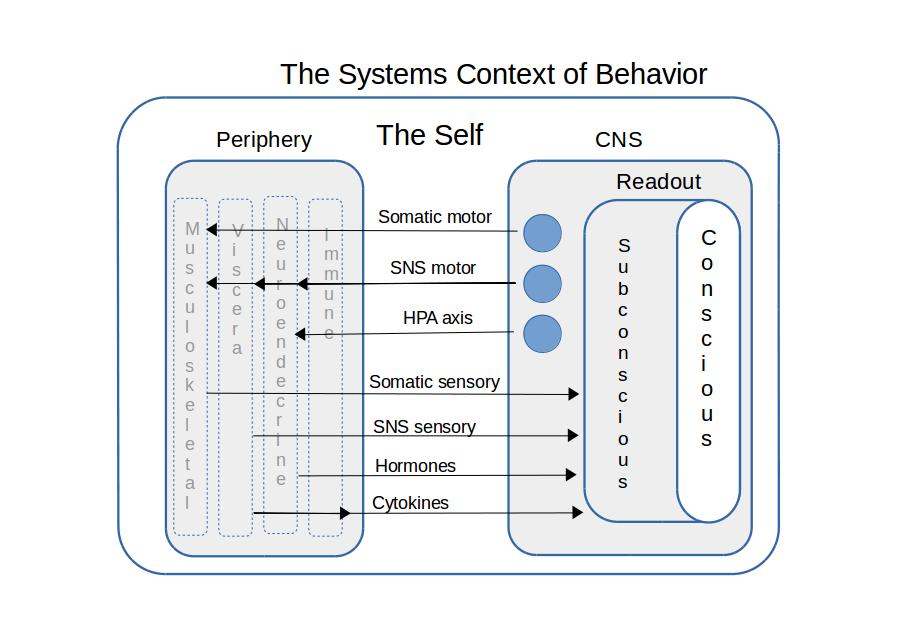
Figure 1: The Systems Context of Behavior shows abstractly how neural control systems partner to allow the central nervous system to maintain homeostasis and to effect allostatic changes. In the diagram, the "self" is split into two entities, the periphery and the CNS. The periphery includes the musculoskeletal system, the viscera, the neuroendocrine system (endocrine glands and their neural connections), and the immune system.
The arrows pointing from the periphery into the CNS represent flows of information.
The array of signals arriving from the periphery is continually updated, which provides the CNS with a real-time readout of the state of the body. Most of this readout is subconscious. Only certain parts of it are available to your consciousness.
Not shown in the diagram are inputs to the CNS from the external sensory organs, sight, sound, and so on.
The arrows leading from the CNS into the periphery represent flows of control from the CNS to the body. The blue circles shown within the CNS represent functions of the CNS.
These systems of the CNS and periphery partner to inform the CNS of the state of the body and to keep the body state adjusted to circumstances. Much of this happens automatically and subconsciously: blood pressure, pulse rate, body temperature, and others are adjusted without your effort or awareness, and you become aware of the adjustments after the fact if at all. This is so far a picture of a passive system that reacts to existing circumstances as needed. What about active behaviors?
These same systems are key to regulation of behavior. They perform several functions.
This last function is key to biological adaptation, and requires additional CNS functionality, emotion and learning, to be effective. See A Rational Model of Emotion and Pain.
Within this section...
The Autonomic Nervous System (Last updated: Fri, Mar 21, 2025)
Pain and the Sickness Response (This page is incomplete.)
Or skip to...
Pain Measurement (Last updated: Sun, Jul 28, 2024)