Please use the form below to submit comments. Also provide an e-mail address and name. Your e-mail address and/or name will be used only to communicate with you about this or future comments you may submit. I am particularly keen to receive references to published material that contradicts the assertions and arguments I have made.
By submitting the above comment, I grant to Ross Alan Hangartner the right to incorporate the comment in full or in part, literally, paraphrased, or conceptually, as he sees fit, into State of Pain or other writings that he may create in the future. However, I don't grant permission to include my name or e-mail address, or to use them in any other way than to contact me for follow-up. I understand that by submitting the comment I acquire no right of any kind in State of Pain or other writings of Ross Alan Hangartner.
Last updated: Fri, Jul 26, 2024
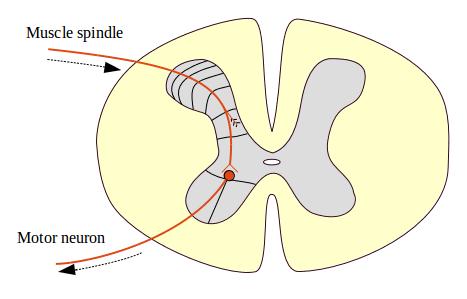
The muscle stretch reflex is not a pain-related phenomenon, but it is one of the simplest spinal reflexes. The stretch reflex shows itself when a muscle is stretched or released suddenly (Figure 1: Muscle stretch reflex) without being ordered to by the central nervous system. Muscle fibers are equipped with muscle spindle receptors that continually report on how much the muscles are stretched. When the amount of stretch changes suddenly, it triggers the reflex. If the muscle is suddenly stretched, the reflex responds by contracting the muscle. If the muscle is suddenly relaxed, the reflex responds by relaxing the muscle. The reflex therefore promotes stability. (You might imagine yourself standing in a moving bus or train.) Following the initial quick adjustment, the reflex continues stabilizing the state of contraction of the muscle.
Your doctor may elicit the muscle stretch reflex intentionally by striking the tendon below your knee cap with his little rubber tomahawk. This stretches the quadriceps muscle on the top of your upper leg and, if all goes well, your lower legs kicks up. If the kick is normal, this simple test tells your doctor that several parts of your equipment are working properly. The nerve pathways into and out of the spine are not impaired. If they were, the response would be weak. Descending pathways from the brain regulate the sensitivity of the spinal cord, so a normal kick also indicates that your spinal sensitivity is in the normal range.
This is a very quick reflex. The sensory fiber from the muscle spindle sensor is the fastest type in your body, and the reflex involves only a single synapse.