Last updated: Sat, Mar 22, 2025
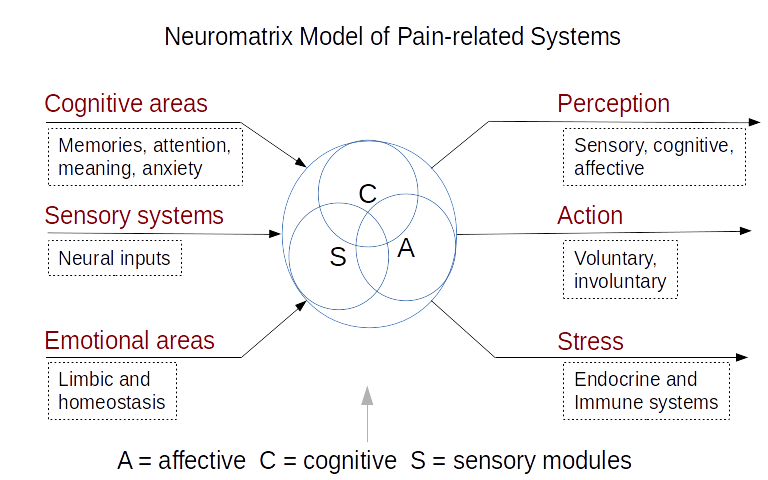
In the section on The Basic Anatomy and Physiology of Pain I described the major pieces of the nervous system that process the signals that result in pain. The Pain Matrix describes the structures or processing centers within the brain that make up the pain network. Ronald Melzack and other pain researches have combined these physical pieces into an abstract model of pain processing that they call the Neuromatrix Theory of Pain and that I call the neuromatrix model. See Figure 1: Neuromatrix Model of Pain Processing.
This model views our pain processing system as a pain processor (the large circle at the center of the figure) that takes inputs from various parts of the nervous system and produces outputs that affect the body as a whole and various parts of the nervous system.
The large circle in the center processes pain information along with other information. It contains three smaller and overlapping circles that represent "modules" that process the affective, cognitive, and sensory dimensions or aspects of pain. The modules are made up out of the brain areas that are described in The Pain Matrix, and have been identified largely through the brain imaging techniques I've described. The three inner circles overlap intentionally, to indicate that the three processes overlap.
Inputs to the model come in from the left side of the diagram. The cognitive inputs of the model include memories, attention, meaning, and anxiety. The emotional inputs include inputs from the limbic system as well as from other systems (largely in the brain stem) that are concerned with the maintenance of homeostasis.
The outputs from the pain processor include perceptions, actions, and stress responses that occur via the endocrine and immune systems, as described in Pain Science 4: Partner Systems.
The message of this model is that pain processing involves much more than just pain. The inputs include the individual's history and current status, and the outputs include actions, complex perceptions, and adjustments to the endocrine and immune system.
If you examine the diagram, you may notice that it fails to depict a number of feedback and feedforward loops that are known to exist. For example, outputs that affect stress also affect the cognitive, sensory, and emotional inputs of the model. The purpose of a model such as this one is primarily, I think, didactic (teaching). It is useful for pointing out major features of a complex system that you deem important. It's safe to suppose that Dr. Melzack considers the separation of pain into three components (cognitive, emotional, and sensory) to be important, since the model declares that feature thrice. On the other hand, it is important to bear in mind that the model is not the system itself. What is true is the system itself.