Last updated: Wed, Jun 21, 2017
The flexor reflex causes a limb to be withdrawn reflexively from a source of irritation. It responds most powerfully to sudden pain, but may be elicited by non-painful stimulation under some conditions. It's called the “flexor” reflex because it works by causing the flexor muscles of the limb to contract. The classic example of the flexor reflex is the hand on a hot stove burner. The reflex causes the arm flexor muscles, primarily the biceps, to contract. Of course, to work well it must simultaneously cause the opposing muscle (the triceps) to relax.
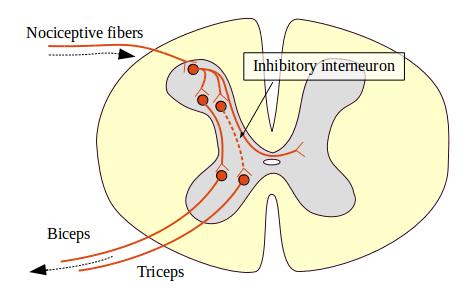
Figure 1: Flexor reflex shows the minimal circuitry for a flexor reflex. The reflex must excite the neurons that activate the muscles of the biceps while they inhibit the neurons that activate the triceps muscle. The signals don't pass directly from the sensory fibers into the motor neurons, but pass through the pool of interneurons. The shortest path through the circuit passes through three or four neurons, although most paths are longer than this. The complete reflex requires several types of circuits: 1) diverging circuits that spread the signal across the set of motor neurons needed to accomplish the flexion part of the response; 2) additional diverging circuits to spread the signals that suppress contraction of the opposing muscle; 3) reverberation circuits to sustain the withdrawal.As is the case with muscle stretch reflexes and Golgi tendon reflexes, the flexor reflex involves both ascending and descending communication with the brain stem and higher parts of the brain. Ascending signals apprise the brain about the initial stimulation and the withdrawal movements, so that the brain can respond appropriately (by moving the body away from the source of irritation, for instance). Descending signals inhibit or excite the neurons involved in the reflex. The descending signals are able to prevent the reflex altogether or, at the other extreme, can excite the cord so that innocuous stimulation is enough to trigger the reflex.
When a body part other than an extremity is stimulated, a different and more complex sequence of muscle actions may be needed to withdraw the part from the source of stimulation. The term withdrawal reflex is used in such a case. Although the general scheme of the withdrawal reflex is the same as for the flexor reflex, it may require the coordination of a large number of muscle groups up and down the spine.